




01
Athlete
The Athlete does the work. Every task runs against a written standard.
Hi, I'm Nicole Jolie.
AI isn't a search box anymore. It's the foundation a business runs on, and foundations get designed before anything gets built.
That's the work. AI OS architecture.
Getting found and recommended by AI systems is what happens after.

Why I do this
I built a business I can't wait to get back to.
I'm up before the sun. I'm at the gym while it's still dark. And the whole time I'm thinking about the work.
That's not discipline. That's love.
There is nothing I would rather do than this. So I do it every day, at full attention, and it shows in the results.

Speaker on AI visibility and AI operating systems.

The proof I can show you
I built my entire AI operating system, rebuilt all three of my websites, closed a full year of books in one eleven hour day, and stood up a content engine that publishes daily.
When a bot attack stuffed my subscriber list with more than 2,000 fake emails, my system flagged it, I purged every one of them the same night, and by morning all three sites were hardened. The next attack bounced off without touching the database.
I am my own proof of concept. I don't pretend to do something for you that I haven't done for myself.

What I check first
When a business buys a website or an SEO package, ownership is rarely part of the conversation. The site gets built. The invoice gets paid. What nobody explains is whose account any of it sits in.
One company came to me after fifteen years and five agencies.
None of it was theirs.
They hadn't done anything wrong. They bought what they were sold, from people who sold it that way on purpose.
That's the flaw in a turnkey site. It's built to be easy to buy and hard to leave. When the relationship ends, the business finds out how little of it was ever in their name.
Where I start:
Answer Engine Optimization and Generative Engine Optimization are what everyone is selling. Both of them sit on top of something. That something is AI OS architecture, and if it isn't yours, none of the rest holds.
A machine can't recommend a business it can't verify. And you can't fix what you don't hold.
The foundation
It has three parts.
The Athlete does the work. Every task runs against a written standard.
The Muscle carries the load. A dedicated machine that runs the heavy work without anyone watching it.
The Judge scores it. An independent audit that reads the record every week. It can find a problem. It cannot fix one. It never touches the work it grades.
The one who does the work never scores the work.


What it can do for you
Showing up in an AI answer is what people notice. It's not what the work is.
This is a single week inside one client's operating system, priced against what the same work costs when you buy it from professionals. The numbers are estimates built from the work record. The work itself is verified.
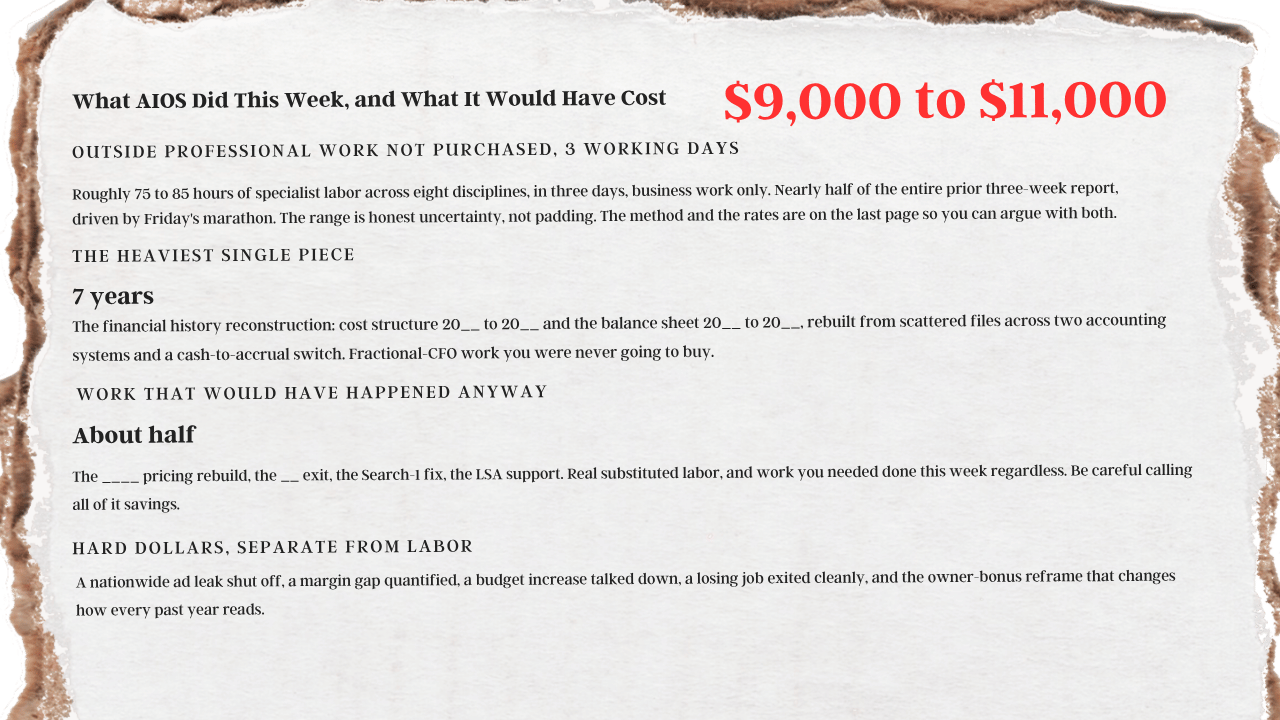
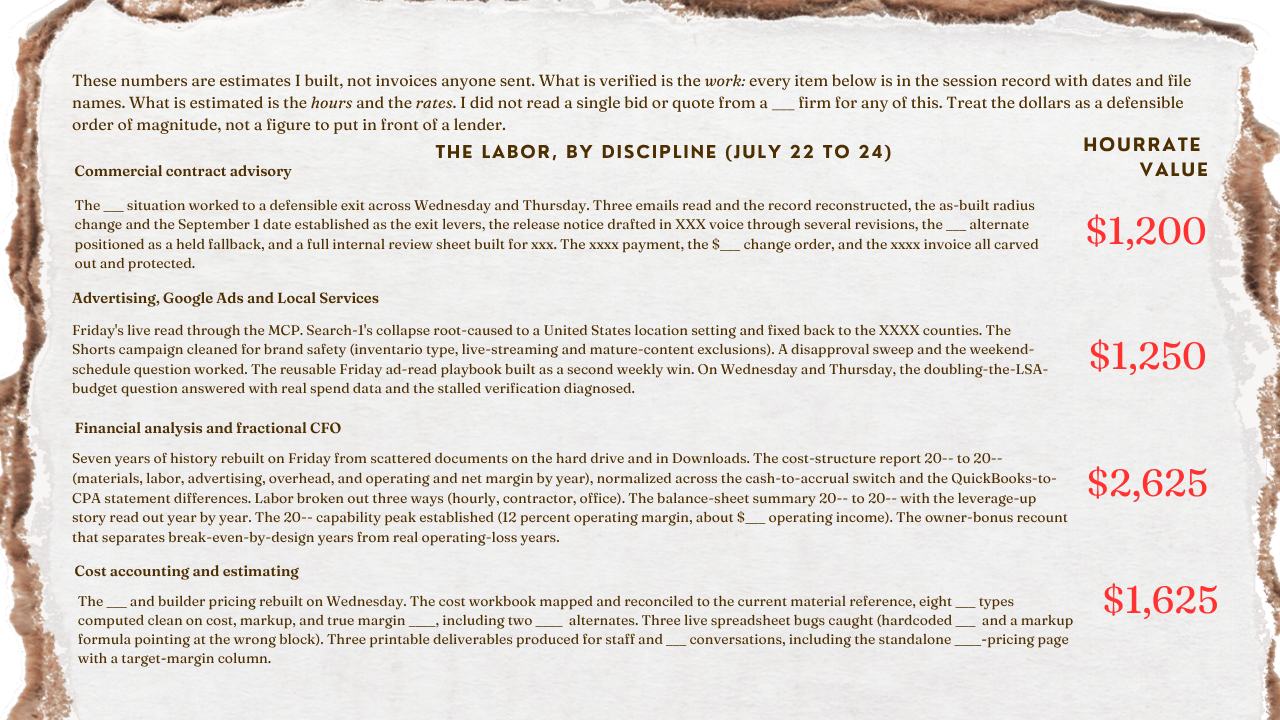
These figures come from one real client engagement, based on the work the operating system actually completed. Every item is in the session record with dates and file names. The hours and the rates behind the dollar values are estimates. The work itself is not.
One month, one business
None of that is reachable by anything pointed at search.


When the system overruled me
The close rate dropped. The obvious move was to spend more on ads.
The system tested that against the account's own history and rejected it. Estimate volume was seasonally normal. A data error in the prior month's report had made things look worse than they were. Conditions in the market explained the rest.
The answer wasn't more spend. It was the two hundred estimates already sitting in the business, waiting.
No AI search tool reaches that conclusion. It takes the pricing, the call logs, the ad data, the estimate history, and the financials in one place that can be asked a question.
That's the difference between a tool and an operating system.
It grades itself
Every week the Judge audits the whole operating system and scores it out of 100. Not the marketing. The system itself. Whether the records are current, whether the checks actually ran, and whether anything was quietly left out.
Those are the real scores, in the order they happened. The number went down and it is still on the page.
The score on its own is not the useful part. Each one arrives with a written list of exactly what was failing that week, and that list is what gets worked on. A score with no failures attached tells you nothing except that somebody wanted to look good.
Most AI gives you confident answers and no error record. Mine keeps a log of its own mistakes and somebody who did not do the work reads it.
The error log isn't the weakness. It's the proof.

Nobody gets replaced
One of the jobs this month was a delegation audit and a thirty minute hand-off for a staff member.
The system read the live account, found half the work was already done, and cut the hand-off in half.
Not a forecast. Measured positions, pulled on a date.
As of July 22, 2026
Fifteen years invisible
A company that spent fifteen years invisible. Google never indexed them. Bing never indexed them. AI didn't know they existed. Today they're number one in AI share of voice against 103 tracked competitors, named in 42.2% of AI answers in their market every week.
*The first one hasn't been touched in a month. The number is holding while the work moved to everything underneath it.
She got her week back
A leader who got her week back. An operating system built for one person that returns six to eight hours every week. First month, measured against the work record: 100 hours absorbed. At a $90 an hour floor, that's a $9,000 month at a $108,000 a year pace.
Known, never recommended
An eight figure brand every AI knew and none recommended. More than 50,000 visitors a day. Every platform recognized them. Not one recommended them. Today they hold number two in their market, ahead of four household names, and land in the top spot in 62% of their AI appearances.
Promises are what the hype sells. I keep receipts.
I built every one of these by hand. Five AI operating systems, four businesses, one architect.
There aren't many people doing this yet. There will be. Right now I'm one of the few who has done it more than once and can show you the record.
I'm not scaling by taking on more clients. I'm scaling by teaching this.
An AI Operating System, or AIOS, is the layer a business runs on. Not an app the business opens. The place the work happens. It holds the company's standards, keeps a dated record of every decision, and gets better the longer it runs. An assistant answers when you ask. An operating system runs the business with you.
It is the discipline of designing that system before anything gets built on top of it. Which standards it holds. What it records. How it checks itself. Who can change what. Most AI work starts with a tool and hopes structure follows. Architecture starts with the structure.
The part that does the work is separate from the part that checks it. Three parts. The Athlete does the work against a written standard. The Muscle carries the heavy scheduled load. The Judge audits the record every week, can find a problem, and cannot fix one. The one who does the work never scores the work.
No. It is not built on any single model. Models are parts inside the system, and parts get swapped when better ones arrive. What stays is your structure, your standards, and your record.
You own your business. Your accounts, your records, your standards, in your name. That is the first thing I check before anything gets built. What I use to build it stays mine.
No, and I will not build it for that. It is built so the people you already have go further. One month's work included a delegation audit and a thirty minute hand off for a staff member. The system read the live account, found half of it was already done, and cut the hand off in half. It did not remove her. It gave her back her afternoon.
No. It will make a bigger one, faster. AI multiplies whatever it is given. Give it order and you get more order. Give it a mess and you get that mess in a hundred places instead of one. The cleanup comes first and it is done by hand. That is the foundation the system sits on.
No. You need to follow the system and check the work. It rewards precision and it punishes guessing. It trains you while you are training it.
Answer Engine Optimization, or AEO, is how a business gets named when someone asks an AI a question. Generative Engine Optimization, or GEO, is how a business gets pulled into an answer an AI writes. Both sit on top of something. That something is AI OS architecture. If the records underneath are not yours and not accurate, neither one holds.
Three things AI checks before it recommends a business. Authority means the work is documented, not claimed. Recommendability means the signals stay consistent, because a governed system does not contradict itself. Citation means there is something in writing that can be cited at all. You cannot be cited for something nobody wrote down.
Start here
Every week: what I actually built, what broke, and what I fixed and made a law. Plus first access to every training I run.
Before anything gets built, I find out where a business actually stands inside AI answers.
You can see yours in fourteen days, free.
Nobody's talking behind your back. That would mean they knew you were there.
Get your number